

There are awards that look good on a shelf. Then there are awards that mean something because of the people who helped put them there.
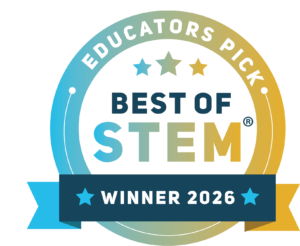
We are incredibly proud to announce that STEM Sports® has been named a 2026 Educators Pick Best of STEM® Award winner in the “Trailblazers: Middle School STEM – Sports Based Learning” category.
For our team, this recognition is about much more than adding another award to the trophy case. The Educators Pick Best of STEM Awards are unique because STEM educators themselves play a central role in evaluating the products and resources being recognized. That makes this honor particularly meaningful to us.
After all, educators are the people who take STEM Sports from curriculum on a page to students measuring, calculating, designing, experimenting, collaborating, moving and discovering.
They are the ones who make it work.
And they are a big part of the reason we are celebrating today.
What Is the Educators Pick Best of STEM Award?
The Educators Pick Best of STEM Awards recognize outstanding products, technologies and services in STEM education. Unlike awards determined primarily by an editorial board or industry panel, the Best of STEM program puts educators at the center of the evaluation process.
According to Best of STEM, it is the only K–12 and higher education EdTech awards program judged exclusively by credentialed STEM educators. Classroom teachers have evaluated more than 150 products across six award cycles since 2021, helping identify resources that can make a meaningful difference in today’s learning environments.
For the 2026 awards, products were independently reviewed by STEM educator judges, with finalists moving on to an educator popular vote before winners were selected. That process is one reason this recognition means so much to us.
STEM Sports was created for educators and students. Being recognized through a program built around educator evaluation provides valuable validation that our approach to teaching STEM through sports is resonating with the very people it was designed to support. By the way, we won Best of STEM Awards in 2023 for Culturally Relevant Teaching Grades K-5 and in 2024 for Culturally Relevant Teaching & Learning.
Why “Sports Based Learning” Matters
The name of our winning category tells an important part of this story: Trailblazers: Middle School STEM – Sports Based Learning.
Sports and STEM might look like two separate worlds at first. We see them as teammates.
Think about what happens during a typical game. A basketball changes direction because forces act upon it. A soccer player makes decisions involving angles, speed and probability. The flight of a golf ball can become an exploration of gravity and trajectory. The design of a football, hockey stick or athletic shoe can open conversations about engineering, materials and technology.
STEM is already happening on fields, courts, courses and rinks every day. Our job is to help students see it.
STEM Sports uses sports as a real-world application for STEM learning, giving students opportunities to investigate academic concepts through activities connected to games many of them already know. Students don’t simply read about concepts such as force, motion, energy, probability, engineering or technology. They have opportunities to see those concepts in action.
A middle school student might calculate field goal percentage like a professional basketball player. Another might compare the energy and motion of different types of footballs. Students can explore the relationship between physical activity, calories and heart rate or investigate the technology involved in improving volleyball serving speed.
The sport creates the connection. The STEM learning takes it somewhere deeper.
Middle School Is an Important Time to Make That Connection
We are particularly excited to receive this recognition for middle school STEM.
Students in grades 6–8 are at an important point in their educational journey. The concepts they encounter are becoming more sophisticated, and the question behind the lesson can increasingly become:
“When am I ever going to use this?”
Sports-based learning gives educators one way to answer that question.
Instead of asking students to imagine where force, velocity, probability, data or engineering might appear outside the classroom, we can give them an application they can see, measure and experience.
A lesson about Newton’s Laws becomes different when there is a basketball in a student’s hands.
A conversation about kinetic energy changes when students can connect it to lacrosse.
Math can take on a different meaning when students are calculating percentages using shots they actually attempted.
Engineering becomes more tangible when students investigate how equipment is designed and then work through challenges of their own.
Those experiences can help turn STEM from an abstract collection of formulas and vocabulary into something students recognize in the world around them.
And importantly, a student doesn’t have to consider themselves an athlete to participate.
The goal isn’t athletic performance.
The sport is the vehicle. Learning is the destination.
This Award Belongs to Our Educators, Too
While our name may be on the award, educators have been building STEM Sports alongside us for years.
Every time a teacher uses a lesson and tells us what worked, we learn.
Every time an educator finds a new way to engage a student through sports, we see another possibility.
Every time a school chooses to make STEM more hands-on, active and connected to students’ interests, the idea behind STEM Sports becomes stronger.
We’ve heard from educators who have watched students make connections between sports and academics that weren’t happening before. We’ve heard from teachers who value having standards-aligned activities that can get students moving while they learn. We’ve seen STEM Sports used in classrooms, after-school programs, summer learning and other settings where educators are looking for new ways to capture students’ attention.
One sixth-grade science teacher in Arizona shared how STEM Basketball connected directly with her regular science curriculum, particularly lessons involving movement and energy. Her students could even connect Arizona’s heat with changes in the properties and bounce of a basketball.
Another educator described STEM Sports as fun and easy to use, while emphasizing the connections students make between sports and academics and the confidence teachers gain from knowing the activities are connected to educational standards.
And one comment from an educator has stuck with us because it captures exactly why engagement matters: a class of middle school students was genuinely excited about doing math and science.
Those stories matter to us.
They remind us that innovation in education isn’t about creating something different simply for the sake of being different. It’s about finding better ways to help educators reach students.
Educators Turn Curriculum Into Experiences
We can develop the curriculum. We can assemble the equipment. We can align lessons with standards. We can create activities designed around the 5E instructional model and incorporate critical thinking, collaboration, creative problem-solving and leadership.
But an educator is the one who brings all of it to life.
Teachers recognize when a student who normally hangs back suddenly wants to participate.
They hear the questions students ask when curiosity starts taking over.
They know when students stop completing an activity because they were told to and start investigating because they genuinely want to know the answer.
Those moments don’t appear in a curriculum guide.
They happen because an educator creates the environment where learning can take hold.
That is why an educator-driven recognition such as Best of STEM feels especially appropriate for this milestone.
Hands-On Learning Has Never Been More Important
There’s another reason this award feels timely.
The Best of STEM program itself has seen an interesting evolution. When the program began in 2020, remote learning influenced nearly every submission. In describing the 2026 competition, organizers pointed to a noticeably different environment: students are once again engaging in hands-on learning and working at the lab bench.
We see that same need in schools.
Technology can be an incredibly valuable part of education, but meaningful learning doesn’t always need to happen through another screen.
Sometimes students need to test something.
Build something.
Measure something.
Throw something.
Collect data.
Change a variable and see what happens.
Work with classmates to solve a problem.
Our printed and digital curriculum options are both designed around that philosophy. Even when educators use STEM Sports digitally, the technology supports the experience rather than replacing it. Students can move between digital instruction and real-world experimentation, using sports to explore what STEM concepts actually look and feel like in action.
The goal isn’t screen time.
It’s discovery.
What This Recognition Means for STEM Sports
Winning a Best of STEM Award is certainly something we’re going to celebrate.
But we also view it as a responsibility.
Being called a Trailblazer means continuing to explore what’s possible.
It means finding new sports through which students can discover STEM.
It means continuing to listen to educators about what they need.
It means making curriculum practical enough for a teacher, coach, club leader or after-school instructor to implement while maintaining the academic rigor schools expect.
It means helping more students understand that STEM isn’t confined to a textbook, laboratory or computer screen.
And it means continuing to answer one of education’s most important questions:
How do we help more students want to learn?
We believe relevance is an important part of the answer.
When students recognize something they already enjoy inside a lesson, educators have an opportunity to build a bridge from what students know to what they have yet to discover.
Sports can be that bridge.
To the Educators Who Helped Us Get Here: Thank You
This is the part that matters most.
Thank you.
To the teachers who have brought STEM Sports into their classrooms, thank you.
To the after-school educators and program leaders who have given students another place to discover STEM, thank you.
To the curriculum leaders and administrators willing to explore a different approach to STEM education, thank you.
To the educators who have shared feedback, stories, ideas and recommendations with us, thank you.
And to the educators who evaluated this year’s Best of STEM entries and helped recognize STEM Sports as a 2026 winner, thank you.
You have helped us demonstrate something we’ve believed from the beginning:
STEM doesn’t have to feel separate from the things students already love.
A basketball can become a science experiment.
A soccer field can become a math classroom.
Sports equipment can become an engineering challenge.
A game can become an opportunity to ask, test, measure, analyze and discover.
And sometimes, the student who didn’t think STEM was “for them” simply needed a different way into the lesson.
We’re incredibly proud to be a 2026 Educators Pick Best of STEM Award winner for Trailblazers: Middle School STEM – Sports Based Learning.
But even more than that, we’re grateful for the educators who helped make the journey possible.
This win belongs to you, too.
Ready to Put STEM Into Play?
Discover how STEM Sports can help you bring standards-aligned, hands-on STEM learning to students through the sports they already know and love.